Showing posts with label books. Show all posts

Wednesday, 26 November 2014

Roman Bookseller

Booksellers in Ancient Rome

In antiquity, the author wrote the original manuscript of his work himself or dictated to a scribe slave. The manuscript was then given to a publisher, who had it copied by professional scribes, who were usually slaves. Before distribution, the ancient Roman books were proofread by an editor (lat. corrector) for mistakes. However, sometimes this was done rather poorly, as the geographer Strabon (63 BC – 19 AD) complained about error-ridden copies in Rome and Alexandria’s bookstores. From an exchange of letters between Cicero and his publisher and friend Atticus, it can be seen that Atticus even recalled books that were already at the booksellers upon Cicero’s request in order to make late corrections.
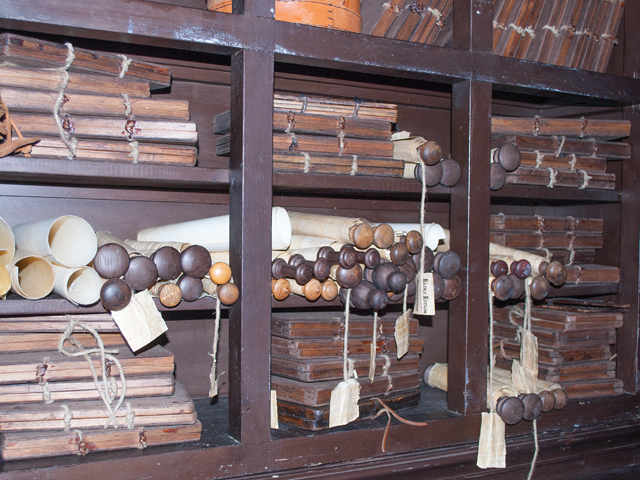
Roman books - bookseller

For early Christianity, we are given indications for the entire process of editing, publishing, distributing and selling of books in the city of Rome and beyond. In the so-called Shepherd of Hermas we read:

(2) The elderly woman came and asked if I had already given the book to the presbyters. I said that I had not. 'You have done well', she said, 'for I have some words to add. Then, when I complete all the words, they will be made known through you to all those who are chosen. (3) And so, you will write two little books, sending one to Clement and the other to Grapte. Clement will send his to the foreign cities, for that is his commission. But Grapte will admonish the widows and orphans. And you will read yours in this city, with the presbyters who lead the church.[1]
If this short note reflects a typical praxis, then books were published and distributed by the author, once they had been read by a few insiders and amendments had been made by those first readers. But the publishing remained the author’s responsibility, as did the first copying and sending out of the book. The first copies, then, went to specifically commissioned people, as in this case to Clement who was the agent for foreign cities. These agents made further copies (as otherwise Clement could not have sent the book to a number of foreign ‘cities’), while others, as here Grapte, used their copy for instruction. The reading out of the book to the leading people in the community, the presbyters, without handing it out, lay with the author. Books, therefore, did not simply make their way into the public domain. As today, there existed proper structures and procedures for writing, correcting, proof-reading, revising, publishing, copying and distribution processes that led to a diverse readership with regards to location, purpose and intent.


[1] Herm. vis 2.4 [8], trans. B.D. Ehrman, Loeb Library.

Wednesday, 19 November 2014

Ancient Books

Ancient Roman Books

In antiquity, the standard form of books was taken from Pharaonic Egypt, scrolls usually made of papyrus and rarely of parchment. In ancient Rome, these book scrolls were widespread with Greek and Latin texts starting in the 3rd / 2nd century BC. The oldest Greek literature is likely that of Homer from 700 BC. It was not preserved as contemporary scrolls. Still, it can be assumed that the use of scrolls in Greece goes back to archaic times. In Greece, pictorial representations of scrolls exist from the 5th century BC.
But the oldest original findings of Greek papyrus scrolls come from Egypt. They date back to the 4th century BC. At that time, the great philosophical schools of Athens already owned book collections. The founding of libraries in several capital cities of Hellenic kingdoms, for example in Alexandria or Pergamon, helped the ancient book production gain momentum. There is evidence that books were copied in the library of Alexandria and also for these other libraries. The philologists therefore must have had their own book production, or at least one linked to the library.

Ancient Roman Scribes

The scribes in ancient Rome were paid according to the number of written lines. In a Diocletian
price edict (306 AD), three pay levels are listed. In the margin of the text, the lines were counted (stichometry). Since the price for private copies was calculated the same way, copies with stichometric numbers did not necessarily have to come from a bookseller. However, one sample from a bookseller might be a papyrus at the University of Milan, which contains the name Sosos in Greek script at the end of a commentary on Ilias. The papyrus, found in Egypt, could be from the Roman publishing house of the brothers Sosius. The epistles of Horace (65 – 8 BC) were also published by the brothers Sosius.

Changes in Ancient Books

The ancient papyrus scroll remained the predominant form for books until the 2nd century AD. In addition, since the 6th century BC there were early forms of the so-called codex in Greece. The ancient codex (plural codices) originally denoted a stack of wood or wax tablets with writing or that were intended for writing. Later these were also folded or bound papyrus or parchment “stacks” enclosed with two wooden blocks. In Latin, by the way, codex (originally caudex) means “trunk of a tree” or “block of wood”, and later the word meant “book” or “booklet.” In the Roman imperial period, both the Codex as well as the older book form, the scroll, were in use.
In the 4th century AD, the codex became the predominant form of book in late antiquity. Up to modern times, the book form changed very little. With the replacement of scrolls with the codex, however, papyrus was also increasingly replaced by the more precious and expensive parchment, which was also, however, dependent on imports.

Ancient Wooden Tablet Codices as the Predecessor of the Modern Book

The ancient wooden tablet codices remained in use for various purposes in the form of so-called diptych (also triptych or polyptych depending on the number of “pages”) throughout the entire ancient Roman period. This developed in the form of the codex made of parchment papers (rarely from papyrus) bound between two covers. The ancient codex was first in use at the same time as the book scrolls, but by late antiquity (4th/5th century AD) had replaced these as the standard form of ancient books. The oldest papyrus scrolls were even systematically copied to parchment codices. The reason: it was more convenient to use the codices and they were preferred by Christians. The late antique codex in this form is the predecessor of the Middle Age and modern book. 

Sunday, 29 January 2012

Writing in Roman times - Wax tablets and Codices


It has been widely acknowledged and known that the publication of books in antiquity as books or codices derives from the practice of wax tablets, a use that soon in the 2nd to the 4th century AD has replaced the writing and publishing on scrolls. It is quite an experience to hold such a wax tablet and a stylus in hands and see why it was not solely the Christians that made widely use of the codex, but that any Roman school trained girl or boy would be looking for reading in codices rather than scrolls, as from childhood on they were used to reading not only on a single wax tablet, but, as shown in the picture above, in wax tablets that like a codex were bound together at the back with leather straps.
Or compare the polysided tablet here:


(all products here are authentic replicas, available on http://www.the-romans.net/)  

It is easy to imagine that people who have been trained on writing on such tools were naturally inclined to read codices rather than scrolls.
Although much of the early history of the codex-form of the book production is in the dark, we know rather more about the publication process during the first centuries.

In the so-called Shepherd of Hermas written at Rome in the early 2nd century, we read:
(2) The elderly woman came and asked if I had already given the book to the presbyters. I said that I had not. 'You have done well', she said. 'for I have some words to add. Then, when I complete all the words, they will be made known through you to all those who are chosen. (3) And so, you will write two little books, sending one to Clement and the other to Grapte. Clement will send his to the foreign cities, for that is his commission. But Grapte will admonish the widows and orphans. And you will read yours in this city, with the presbyters who lead the church.[1]
If this short note reflects a typical praxis, then books were published and handed out by the author, once they had been read by a few insiders and amendments had been made even by those first readers. But the publishing remained the author’s responsibility, also the first copying and sending out of the book. The first copies, then went to specifically commissioned people, as in this case to Clement who was the agent for foreign cities. These agents made further copies (as otherwise Clement could not have sent the book to a number of foreign ‘cities’), while others, as here Grapte, used their copy for instruction. The reading out the book to the leading people in the community, the presbyters, without handing it out, lay with the author. Books, therefore, did not simply made their way into the public. As today, there existed proper structures and procedures for the writing, correcting, proof-reading, revising, publishing, copying and distribution process that lead to a diverse readership with regards to location, purpose and intent. And, clearly, codices were becoming the form of this early 'mass' production phenomenon, clearly meant and directed as part of a sales chain of a formal book trade.


[1] Herm. vis 2.4 [8], trans. B.D. Ehrmann, Loeb Library.